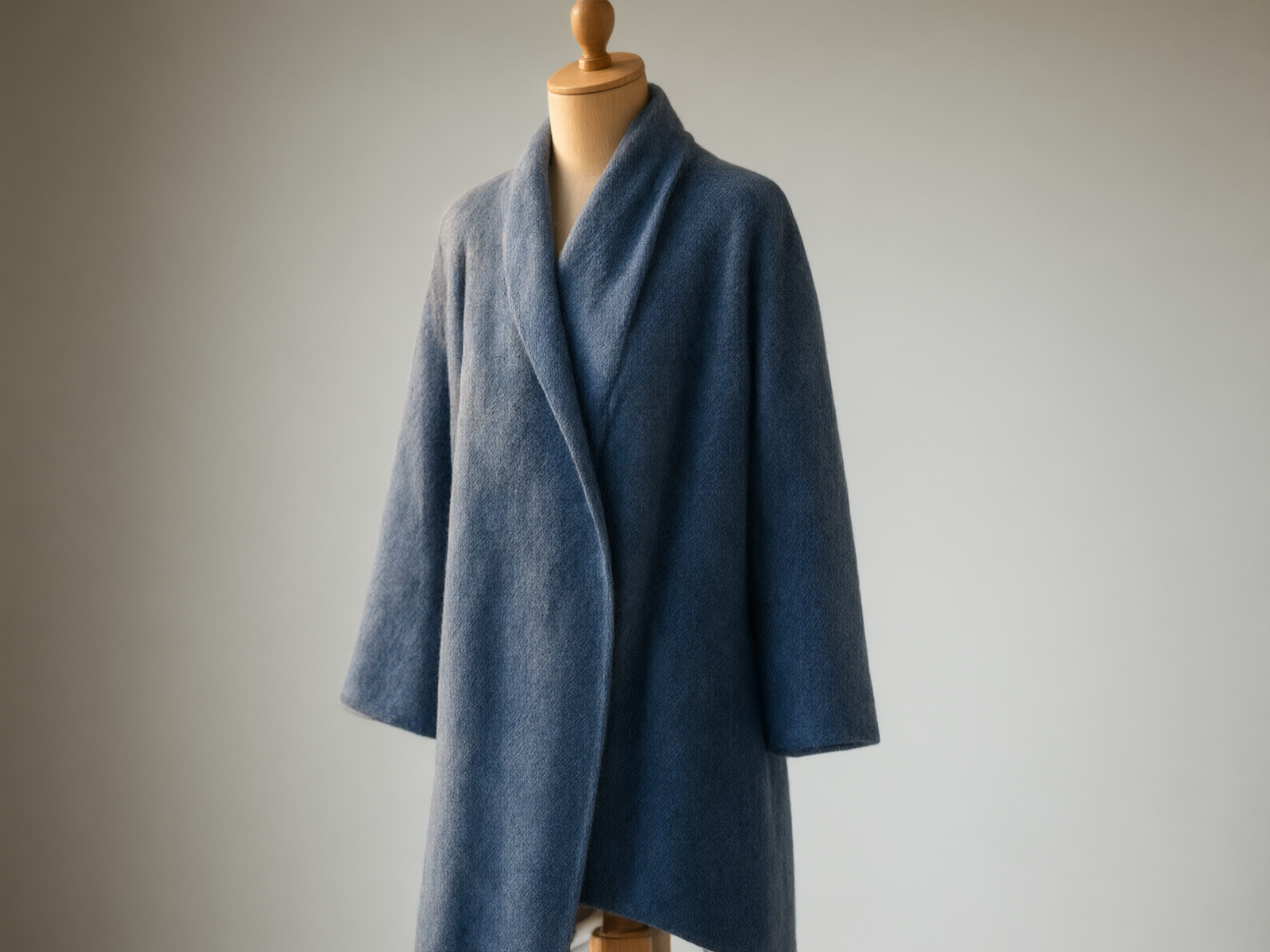
A coat's color arrives before its silhouette. Before a wearer enters a room, before the drape catches light in motion, the hue registers first. At JIANGSÈ, we treat this sequence as a design principle rather than an afterthought. The Indigo Mist Draped Coat, one of three pieces in our Lookbook, offers a concrete case for examining how a color drawn from the Chinese color system operates within a modern Western garment structure.
This article breaks down the Indigo Mist Draped Coat across four dimensions: the color's origin in Eastern chromatics, the technical decisions behind translating that color onto contemporary fabric, the tailoring logic of the draped coat silhouette, and practical styling guidance for the wearer.
The Color: Indigo Mist in Eastern Chromatics
Indigo occupies a distinct position in the Chinese color system. Unlike red, which carries immediate ceremonial associations, or yellow, which was historically restricted to imperial use, indigo exists in a quieter register. It is a color of craft rather than of court. The term "Indigo Mist" refers to a specific tonal range within this family — a blue shifted toward grey, with the muted quality of indigo dye seen in early-morning light, before the sun lifts the color into full saturation.
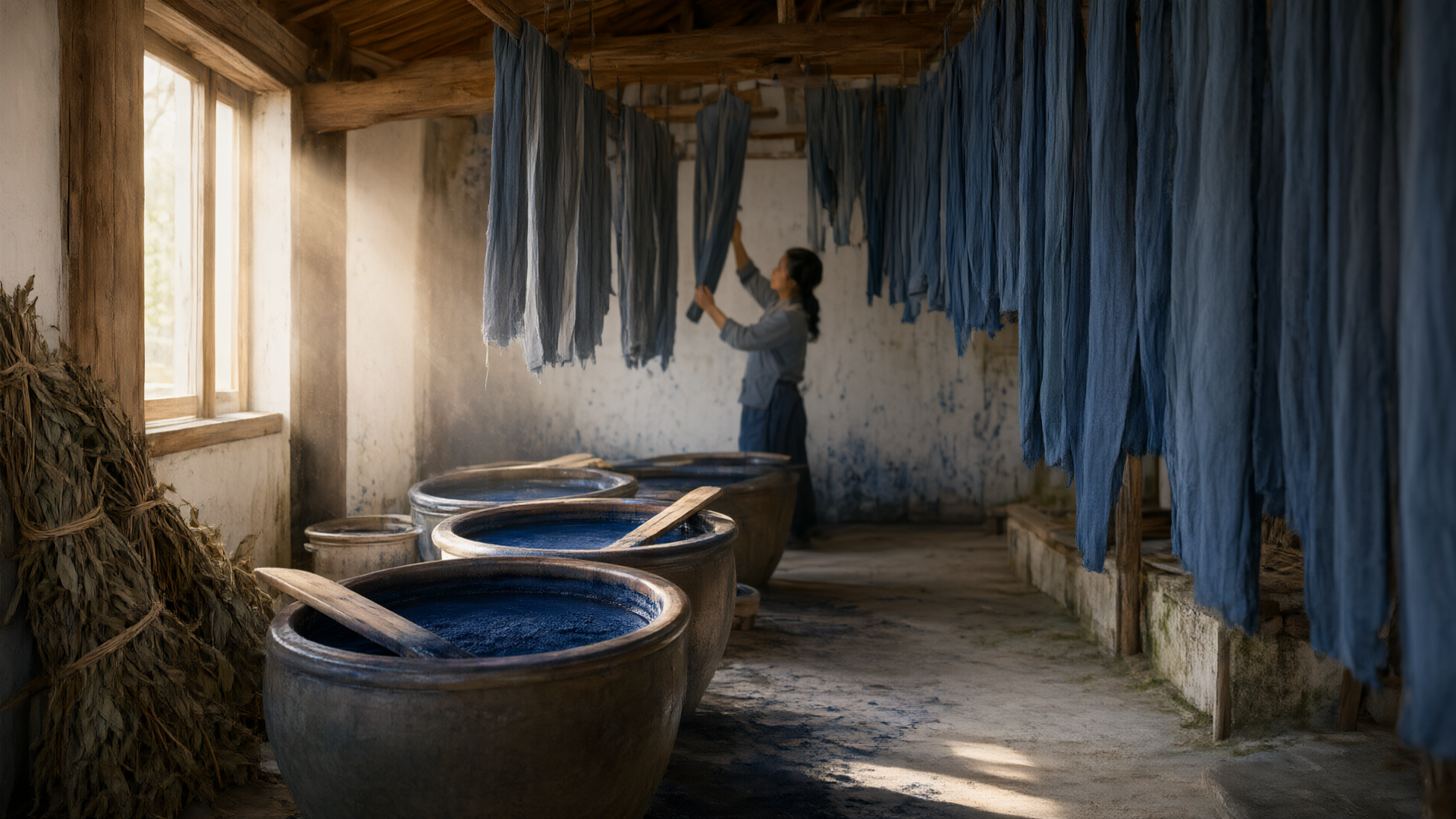
In traditional Chinese dyeing, indigo is extracted from the leaves of plants in the Indigofera genus. The process requires fermentation, oxidation, and repeated dipping — each cycle deepening the hue. The final color depends on variables that resist exact replication: the age of the dye bath, the mineral content of the water, the ambient temperature during oxidation. This means that no two batches of traditional indigo dye produce identical results. The "mist" quality in Indigo Mist captures this inherent variation — a softness at the edges of the color that distinguishes it from the flat, uniform blue produced by synthetic dyes.
Eastern chromatics, as a system, names colors after natural phenomena rather than abstract positions on a spectrum. Where Western color theory organizes hues by wavelength and saturation values, the Chinese tradition ties color to observable conditions: the blue of a mountain in fog, the red of cinnabar after grinding, the yellow of autumn leaves at a specific stage of decay. Indigo Mist follows this naming logic. It is not a Pantone reference. It is a description of a visual condition.
From Dye Tradition to Modern Fabric
Translating Indigo Mist onto a contemporary garment involves decisions that the traditional dye process leaves to chance. At JIANGSÈ, the color development for the Indigo Mist Draped Coat begins with a target tonal value — a specific point on the blue-grey spectrum — and works backward through material selection.
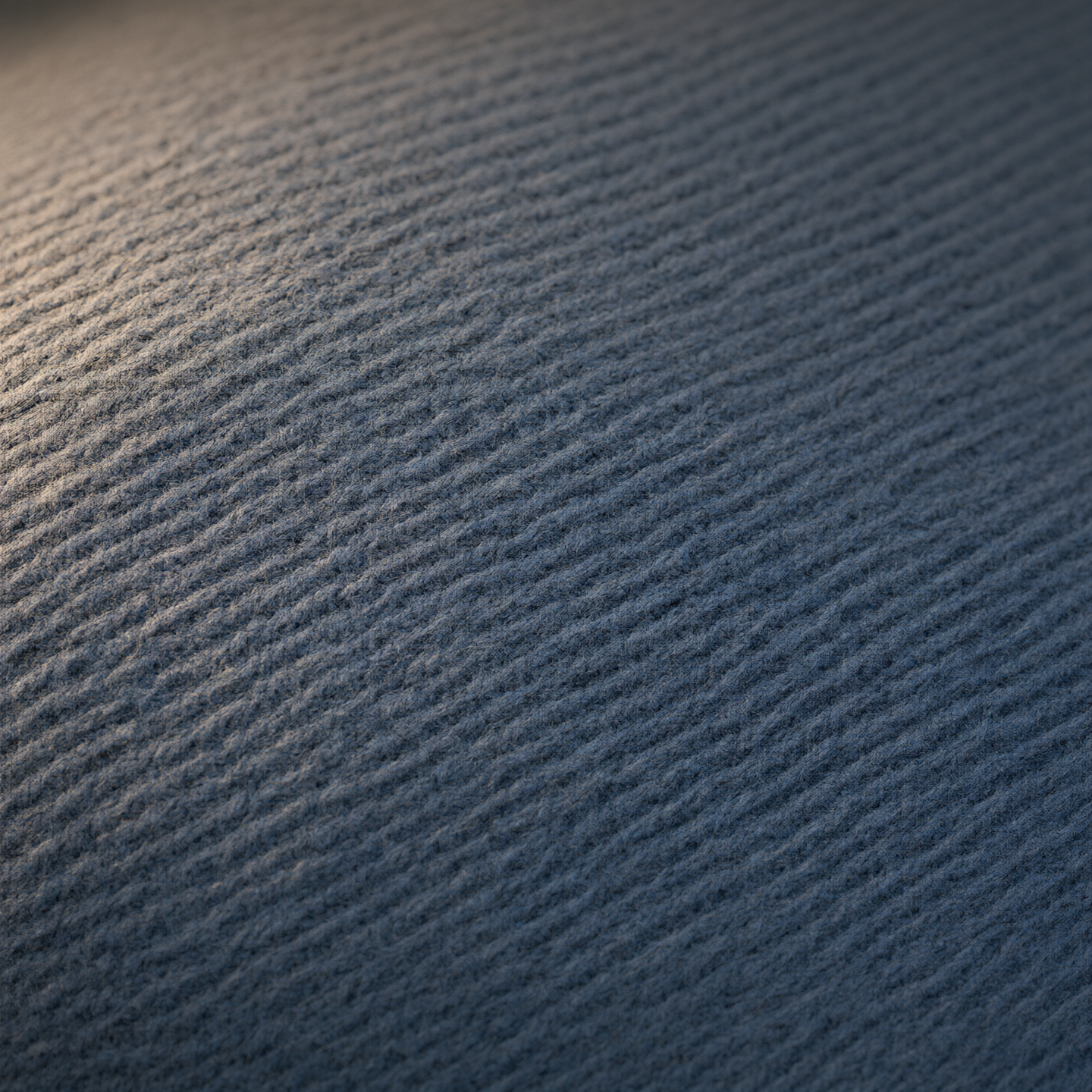
The base fabric for the coat is a wool-blend twill with a slight nap. This choice serves the color: the nap catches light unevenly across the surface, creating subtle tonal shifts that echo the variation found in hand-dyed indigo. A flat-weave fabric of the same dye formula would read as a solid, uniform blue. The twill structure reintroduces the complexity that the traditional process produces naturally.
The dyeing process itself uses a combination of vat-dyeing and over-dyeing techniques. The base layer establishes the primary indigo tone, while a secondary, lighter pass introduces the "mist" quality — a deliberate desaturation that softens the color without pushing it into grey. The result sits between a true indigo and a slate blue, holding the warmth of the former and the neutrality of the latter.
This two-stage approach is not unique to our atelier, but the target color is specific to our system. Each color in our Designer Womenswear collection — from Crimson Rouge to Pine Blossom to Indigo Mist — is developed against a reference drawn from the Chinese color system, not from seasonal trend forecasts. The constraint is deliberate: the color must answer to a historical precedent before it answers to a market cycle.
The Draped Coat: Tailoring Logic
The draped coat silhouette sits between structured outerwear and soft, unconstructed garments. It borrows from both traditions without fully committing to either. The Indigo Mist Draped Coat follows this in-between logic in its construction.
The shoulder line is soft, without padding. This decision removes the architectural rigidity of a traditional coat shoulder and allows the fabric to fall from the body's natural line. The absence of padding is not a simplification — it requires precise cutting, because there is no internal structure to compensate for an imperfect fit across the shoulder. The pattern must follow the wearer's anatomy closely enough that the drape begins at the correct point.
The front closure is wrap-style, with no buttons or visible fastening. A buttoned front creates a fixed, symmetrical line. A wrap closure allows the wearer to adjust the overlap, which changes how the fabric falls and how the Indigo Mist color moves across the body. The drape becomes responsive rather than static.
The coat's length falls below the knee. This proportion serves two purposes. First, it provides enough fabric surface for the color to develop its full visual presence — a shorter cut would compress the tonal shifts that the twill fabric produces. Second, it places the garment in the outerwear category, where it functions as a layering piece rather than a standalone statement.
The sleeve is set-in, with a slight taper from elbow to wrist. This is the most conventionally Western element of the coat's construction. The tailored sleeve anchors the garment's looseness in a precise detail, preventing the overall silhouette from reading as shapeless. It is a common pattern in modern design: one element of strict construction legitimizes the freedom of the rest.
Where Eastern Color Meets Western Structure
The Indigo Mist Draped Coat is not a hybrid in the sense of mixing decorative motifs from two traditions. There are no mandarin collars, no frog closures, no embroidery referencing Chinese iconography. The Eastern element is the color alone — its source in the Chinese color system, its naming after a natural condition, its development against a historical reference rather than a trend forecast.
The Western element is the garment structure: a draped coat with a tailored sleeve, a wrap front, and a below-knee length. These are decisions from the European outerwear tradition, adapted for a contemporary womenswear context.
This separation is intentional. When Eastern and Western elements appear together as decorative features — a mandarin collar on a Western blazer, for example — the result often reads as costume. By restricting the Eastern contribution to color and leaving the structure entirely Western, the garment avoids this tension. The wearer gets a coat that functions within a Western wardrobe system but carries a color that operates by a different logic.
This approach reflects a broader position at JIANGSÈ: Eastern chromatics are treated as a color system, not as a decorative vocabulary. The colors do their work at the level of hue and tone, before any cultural reference is consciously registered. A wearer who knows nothing about the Chinese color system can still respond to Indigo Mist as a color. The historical depth is present but not required for the garment to function aesthetically.
Styling the Indigo Mist Draped Coat
The Indigo Mist Draped Coat's color and silhouette suggest specific styling directions. What follows is guidance based on color theory and proportion logic.
Color pairing operates on two viable paths. The first is tonal: pairing Indigo Mist with other blues in the same value range — a navy knit underneath, slate-grey trousers below. This creates a monochromatic column that lets the coat's subtle tonal shifts become the visual interest. The effect is restrained and coherent. The second path is contrast: pairing Indigo Mist against warm neutrals — camel, oatmeal, or warm white. The blue-grey reads as cooler and more defined against these backgrounds. This direction suits contexts where the coat should register as a distinct layer rather than blending into a unified palette.
For pieces from our collection such as the Crimson Rouge Silk Gown or the Pine Blossom Linen Set, the pairing logic differs because those garments carry warmer base tones. Indigo Mist, being inherently cool, creates a temperature contrast when layered over or alongside warm-toned pieces. This contrast is the mechanism that makes the color combination visually legible.
Proportion guidance follows the coat's below-knee length. The garment's volume is concentrated in the upper body — the wrap front creates fabric overlap at the torso, while the lower half falls in a relatively straight line. Pieces worn underneath should avoid adding volume at the hip or thigh. A slim-leg trouser or a straight-cut dress maintains the coat's intended silhouette. Wide-leg trousers can work if the fabric is lightweight enough to avoid competing with the coat's drape.
Footwear follows the same logic of proportion. A boot with a defined heel extends the line of the coat's lower edge. A flat shoe, particularly one with a rounded toe, can truncate the silhouette and make the coat appear heavier than its fabric weight suggests.
For occasion context, the Indigo Mist Draped Coat occupies a space between formal and casual. It is more structured than a cardigan or open-front knit, and less rigid than a tailored blazer. This makes it suitable for professional environments that allow softness in dress, for cultural events where a considered piece is appropriate, and for everyday contexts where the wearer wants to elevate a neutral base outfit with a single deliberate layer.

Color as Design Decision
The Indigo Mist Draped Coat illustrates a principle that applies across our collection: color is a design decision that precedes and outlasts trend. A silhouette can be updated, a fabric can be substituted, but a color rooted in a system like the Chinese color system carries a stability that seasonal palettes do not.
At JIANGSÈ, each color in our collection — Indigo Mist, Crimson Rouge, Pine Blossom — is developed with this long view. The garments are designed to remain legible as color objects beyond the cycle of seasonal replacement. Whether that intention holds in practice depends on the wearer's relationship to their wardrobe. The design commitment, on our side, is clear.