China's dyeing traditions stretch back over three millennia, yet they remain largely invisible to the global fashion industry. In February 2025, we embarked on a six-week research journey through four provinces — Guizhou, Yunnan, Jiangsu, and Zhejiang — to document the living traditions that continue to inform JIANGSÈ's color development. What we found was not a relic of the past but a thriving, evolving practice.
Guizhou: The Indigo Vats of Danzhai
Our journey began in Danzhai County, Guizhou, where the Miao people have practiced indigo dyeing for generations. The process here is communal — entire villages maintain shared dye vats, ceramic vessels sunk into the earth, filled with fermented indigo solution that is tended like a living thing.
The Miao indigo process differs from the Japanese or Indian traditions in a crucial way: the dye bath is never fully exhausted. Instead, it is continuously fed with fresh indigo leaves, rice wine, and wood ash lye, creating a living culture that can persist for decades. Some vats in Danzhai are said to be over fifty years old, their color deepening with each passing year.
The fabric — typically hand-woven cotton — is dipped repeatedly, with oxidation periods between each immersion. The number of dips determines the depth: eight dips for a medium blue, fifteen for the deep, near-black indigo used in ceremonial garments. The "mist" quality in our Indigo Mist collection draws directly from the early-stage dips — the pale, grey-blue that appears after just three or four immersions.
Yunnan: Madder Fields and Mountain Reds
From Guizhou we traveled west to Yunnan, where the madder root (茜草) has been cultivated for over two thousand years. The fields around Dali and Lijiang still produce some of the finest madder in China, though the acreage has shrunk dramatically as synthetic dyes have displaced natural ones.
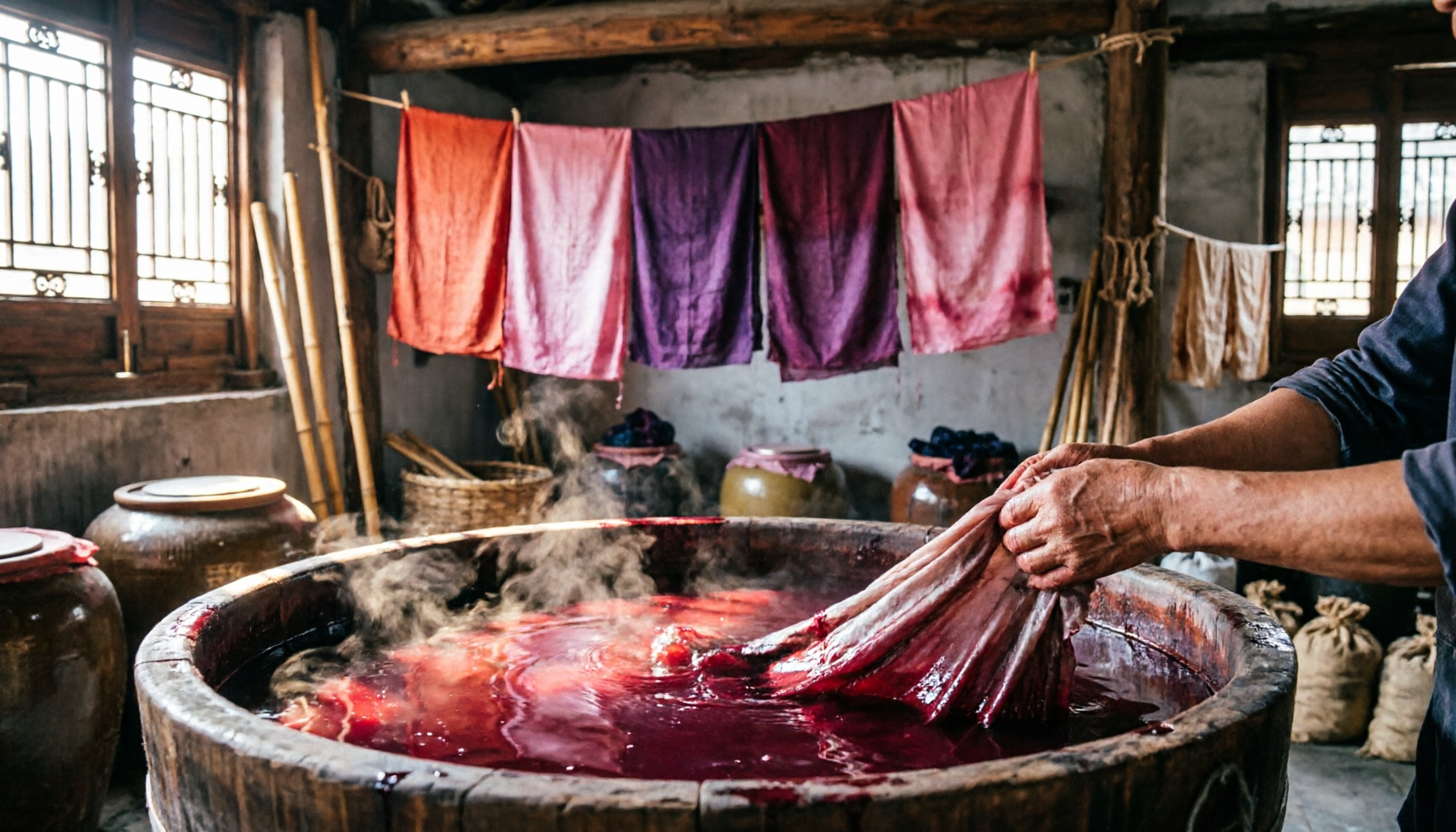
We spent a week with Master Chen, a fourth-generation madder dyer whose family has supplied crimson silk to temples and courts across the region. His process is meticulous: the roots are harvested in autumn, dried for three months, then ground and soaked in spring water heated to exactly 60°C. The first bath produces a pale orange. Through repeated dipping and mordanting with alum, the color deepens through coral, scarlet, and finally the deep crimson that defines our Rouge palette.
Jiangsu: The Silk Weavers of Suzhou
Suzhou's silk tradition needs little introduction. What surprised us, however, was the sophistication of the city's historical dyeing practices. The Suzhou Silk Museum's archive contains color samples from the Song Dynasty that display a tonal range rivaling any modern palette. The dyers of Song-era Suzhou worked with over seventy named colors — each tied to a specific combination of plant source, mordant, and technique.
Our collaboration with the museum, which began in 2023, has given us access to this archive. We have been able to study the exact dye formulas used for colors with names like "autumn water blue," "willow smoke green," and "cinnabar after rain." These names are not poetic flourishes — they are precise technical descriptions of specific visual conditions.
Zhejiang: The Future of Natural Dyeing
Our final stop was Hangzhou, where the China Academy of Art has established a natural dyeing research laboratory that bridges traditional knowledge and modern textile science. Here, researchers are developing methods to improve the lightfastness and wash-resistance of natural dyes without sacrificing their tonal complexity.
The implications for JIANGSÈ are significant. If natural dyes can be made durable enough for everyday wear, the gap between heritage technique and contemporary production narrows considerably. We are currently testing several of the academy's formulations for use in our Spring 2026 collection.
What We Carry Forward
This journey reinforced a conviction that has guided JIANGSÈ since its founding: the most interesting colors in the world are not made in laboratories. They are grown in fields, fermented in vats, and coaxed from roots by hands that have practiced the craft for decades. Our role as a contemporary brand is not to preserve these traditions in amber but to carry them forward — to find ways for a Miao indigo vat, a Yunnan madder field, and a Song Dynasty color name to live inside a garment that a woman wears today.