When the National Gallery approached JIANGSÈ about a collaboration, the premise was both ambitious and precise: create a collection of garments that respond to specific paintings in the Gallery's permanent collection, using the Chinese five-color system as the interpretive framework. The result — "Where Color Meets Canvas" — is an exhibition and capsule collection that opened in June 2025.
The Concept
The collaboration began with a simple observation: Western painting and Chinese color theory organize visual experience in fundamentally different ways. A Turner seascape dissolves color into light and atmosphere. A Song Dynasty color name anchors hue to element, season, and direction. What happens when you read a Western painting through an Eastern color lens?
We selected five paintings from the Gallery's collection and developed a garment for each, using the wǔsè system as our interpretive tool. The goal was not to reproduce the paintings as fabric — that would be mere decoration — but to translate their chromatic content into the language of Chinese color philosophy.
The Five Paintings, The Five Colors
Turner's "The Fighting Temeraire" became our Indigo Mist piece. The painting's twilight sky — that liminal blue between day and night — maps precisely onto the indigo family in the Chinese system. The resulting garment, a long draped coat in graduated blue-grey, captures the painting's elegiac mood without depicting a single element of its imagery.
Vermeer's "Girl with a Pearl Earring" inspired our Crimson Rouge interpretation. The painting's power lies not in its reds — there are almost none — but in the warmth that radiates from the subject's skin against the dark background. We translated this warmth into a silk gown dyed with madder root, the color concentrated at the bodice and fading toward the hem like light falling across a face.
Monet's "Water Lilies" became Pine Blossom. The painting's green-gold surface — neither fully green nor fully yellow — occupies the same liminal space as our Pine Blossom hue. The garment, a flowing wrap dress in raw silk, moves with the same liquid quality as Monet's pond surface.
The Exhibition Design
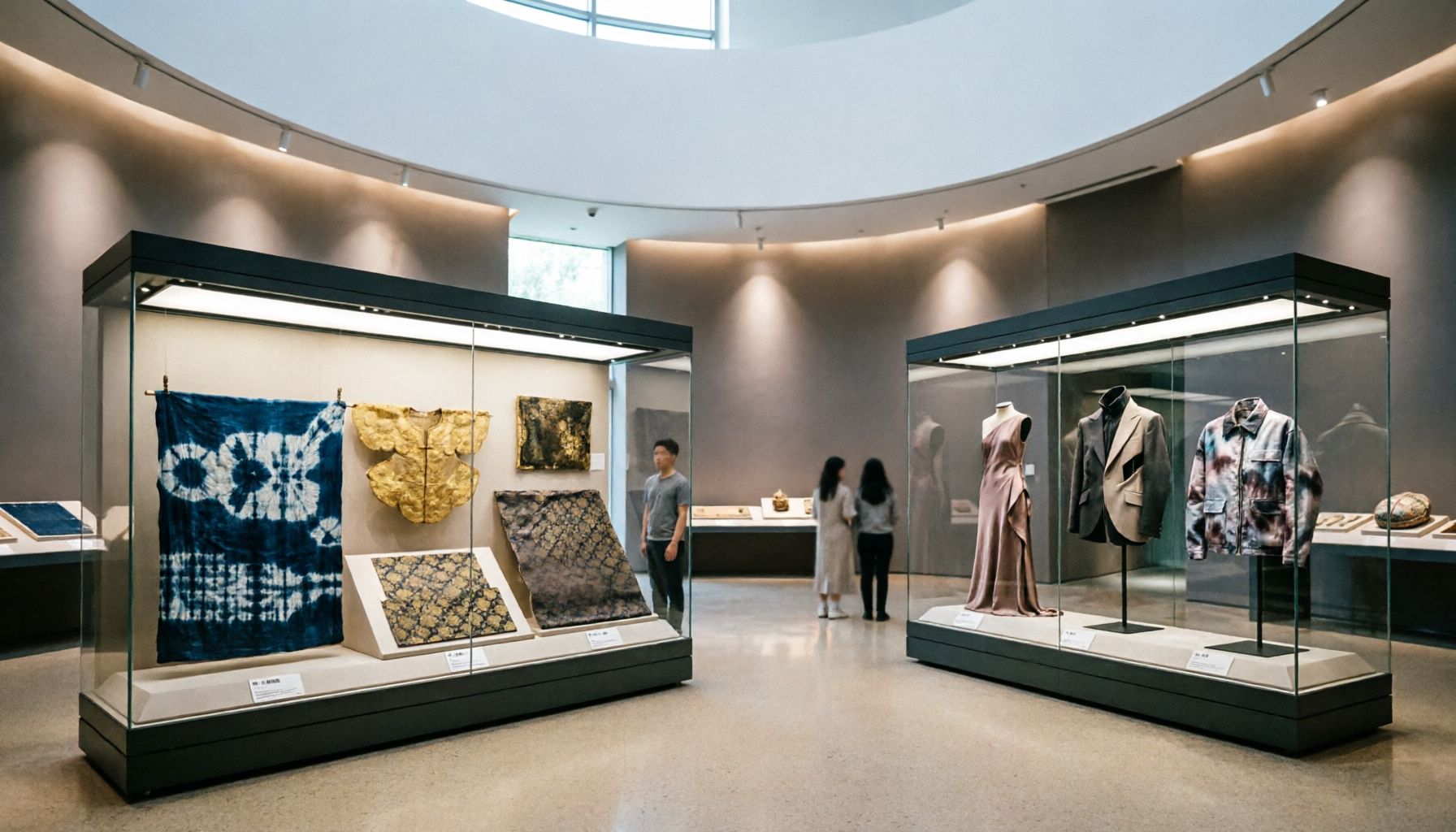
The exhibition was installed in the Gallery's Sunley Room, with each garment displayed in proximity to its source painting. The curatorial decision was to place the garments on freestanding forms rather than mannequins — abstract, architectural shapes that suggested the human body without mimicking it. This allowed visitors to see the garments as color objects first, fashion items second.
Lighting was calibrated to match the Gallery's conservation standards — no more than 200 lux on any textile surface. This constraint, far from limiting the presentation, actually enhanced it. The lower light levels revealed the tonal subtlety of the natural dyes in a way that bright gallery lighting often obscures.
The Dialogue
The most compelling aspect of the collaboration was the dialogue it created between visitors and the paintings. Several Gallery educators reported that visitors who engaged with the JIANGSÈ installation subsequently looked at the source paintings with fresh eyes — noticing color relationships they had previously overlooked. The garments functioned as interpretive lenses, making visible what was already there but unseen.
This was precisely our intention. Fashion, at its best, does not merely clothe the body. It trains the eye. A garment that makes you see a Turner painting differently has done something that transcends the wardrobe.
Looking Ahead
The "Where Color Meets Canvas" exhibition runs through September 2025, with a series of public talks and workshops planned throughout the summer. A limited-edition capsule collection — five pieces, one for each painting — will be available exclusively through the Gallery shop and JIANGSÈ's flagship store.
This collaboration has opened a new dimension for JIANGSÈ. The intersection of Eastern color philosophy and Western art history is richer than we imagined, and we are already in conversation with two other major institutions about future projects. The conversation between color systems, it turns out, is just beginning.